How to Choose a Solar Car Charger?

Time:2026-09-23 Author:Isabella
0%

Choosing a Solar Car Charger requires more than checking its wattage or glossy efficiency claim. It requires matching sunlight, vehicle demand, battery chemistry, and daily driving habits. The International Energy Agency’s Global EV Outlook 2024 reported that electric car sales exceeded 17 million worldwide in 2024, increasing pressure on flexible charging solutions. Meanwhile, IRENA recorded solar power as the largest source of new renewable capacity added globally in 2023. These figures show strong momentum, but they do not guarantee that every solar charger suits every driver.

Fatih Birol, Executive Director of the IEA, said, “The transition to clean energy is happening worldwide and it’s unstoppable.” His statement supports the wider move toward solar-powered mobility, yet practical selection still needs careful judgment. A reliable Solar Car Charger should be assessed through panel output, charging speed, inverter quality, weather resistance, cable safety, and compatibility with your vehicle. A 200-watt panel may perform well under clear midday sunlight, but clouds, shade, dust, and winter angles can reduce output sharply. That difference matters beside a driveway or under a carport.

Look beyond peak power.

Check real-world performance data, warranty terms, and installation requirements. The U.S. Department of Energy also emphasizes that charging results depend on system design and available electricity, not hardware labels alone. A mistake is treating solar charging as completely effortless. It is cleaner, but it is not magically constant. The following guide compares charger types, useful specifications, operating costs, and common compromises, helping readers choose with evidence rather than optimism.
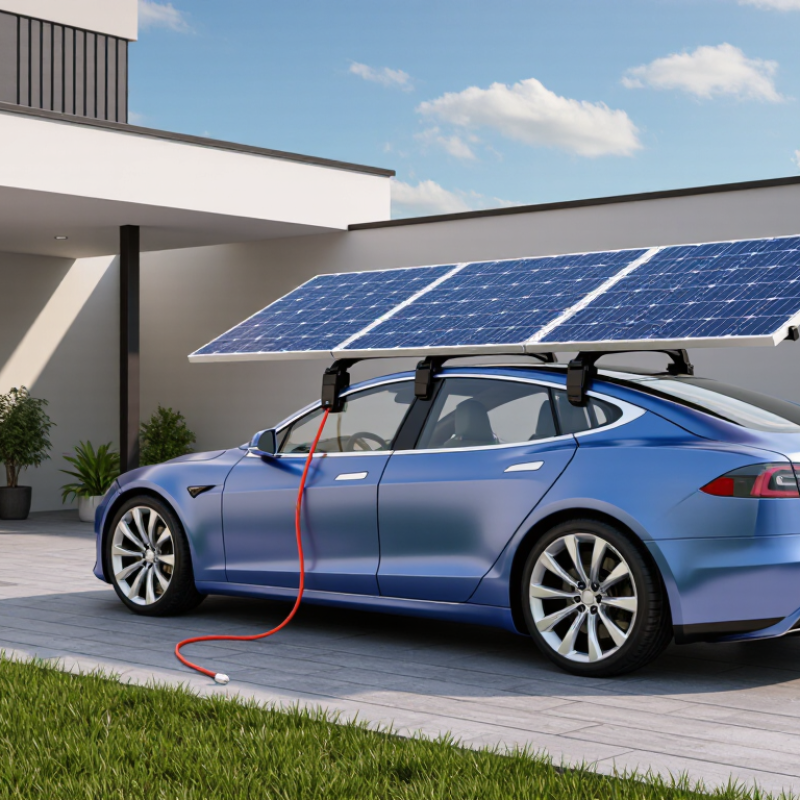
How to Choose a Solar Car Charger?

What a Solar Car Charger Is and How It Works

How to Choose a Solar Car Charger?

What a Solar Car Charger Is and How It Works

A solar car charger uses photovoltaic cells to turn sunlight into direct-current electricity. A small controller regulates that power before it reaches the vehicle battery. This prevents unstable charging during changing sunlight. Most portable models maintain a 12-volt battery rather than rapidly charging an electric car’s main battery.

The panel produces more power in clear, direct sunlight. Behind a windshield, heat and glass can reduce its real output. A 20-watt panel may therefore deliver much less than 20 watts. The calculation is not perfect. Cloud cover, shade, dust, and cable resistance all matter. In practical testing, placing the panel flat on a dashboard often gives weaker results than facing it toward the sun outdoors.

Look for a charger with reverse-current protection and a suitable voltage range. These features help prevent battery drain after sunset. A built-in charge controller is valuable for long-term connection. Check the cable length, connector security, and weather resistance too. Cheap-looking insulation can crack after repeated temperature changes.

Match the charger to your battery’s needs. A small panel may maintain charge during parking, but it cannot replace a proper high-current charger. Read the battery manufacturer’s specifications before connecting anything. Never assume every vehicle socket is suitable. A careful choice is slower, but safer.

Key Factors to Assess Before Choosing a Solar Car Charger

How to Choose a Solar Car Charger?

Key Factors to Assess Before Choosing a Solar Car Charger

When I assess a solar car charger, I first identify the vehicle and charging purpose. A 12-volt battery maintainer is different from a system designed for electric vehicles. Check the vehicle’s voltage, charging connector, and maximum accepted current. A panel rated at 100 watts will rarely deliver 100 watts in cloudy weather, shade, or winter. Real output matters more than the number printed on the packaging.

Charging speed also depends on the battery and storage system. A solar panel connected directly to a car may provide unstable power when sunlight changes. A charge controller or battery buffer can improve consistency and reduce charging risks. Look for protection against overcharging, overheating, reverse polarity, and short circuits. Safety certification from a recognized testing body adds useful evidence, but it should not replace careful installation.

Weather resistance is practical, not decorative. Check the enclosure rating, cable length, mounting method, and temperature range. A cable that barely reaches the vehicle becomes frustrating beside a driveway. Portable panels should fold securely and resist light rain. I once underestimated cloudy-day performance and expected too much from a small panel. That mistake changed my expectations. Read independent test results, inspect the warranty terms, and compare measured output under similar conditions. A clear display can help, but accurate data matters more than extra features.

How to Choose a Solar Car Charger? - Key Factors to Assess Before Choosing a Solar Car Charger

Assessment Factor Typical Range or Benchmark What to Assess Why It Matters Recommended Check
Solar Panel Rated Power 20–200 W for portable charging systems Select a panel size that matches the vehicle battery, parking conditions, and available installation area. A higher wattage generally provides more energy, but also increases size and weight. Solar output varies with sunlight, temperature, shading, and panel orientation. Rated power is measured under standard laboratory test conditions and is not a guaranteed everyday output. Compare the rated watts with the available roof, windshield, garage, or mounting space.
Charging Voltage Compatibility 12 V systems are common; some vehicles use 24 V systems Confirm that the charger’s operating voltage matches the vehicle battery system. The charger should include suitable regulation rather than connecting an unregulated panel directly to the battery. Incorrect voltage can result in ineffective charging, battery damage, or unsafe electrical conditions. Verify the vehicle battery voltage and the charger’s supported input and output voltage ranges.
Charge Controller Type PWM is economical; MPPT can improve solar harvesting PWM controllers are generally simpler and less expensive. MPPT controllers continuously adjust the operating point of the panel and can extract more available energy, especially when panel voltage is substantially higher than battery voltage. The controller protects against overcharging and improves charging stability under changing sunlight conditions. Choose a controller with overcharge, reverse-current, short-circuit, and over-temperature protection.
Expected Daily Energy Yield Approximately 50–800 Wh per day, depending on panel size and sunlight Estimate energy using panel wattage, peak sun hours, system efficiency, and local weather. A practical calculation is: daily energy ≈ panel watts × peak sun hours × 0.70–0.85. A solar charger may maintain a battery or replace a small amount of energy, but a compact system may not fully recharge a deeply discharged vehicle battery. Use local solar data and allow for clouds, shade, dirt, cable losses, and seasonal variation.
Charging Current About 1–15 A for many 12 V maintenance or auxiliary systems Check the maximum regulated current and compare it with the battery capacity and intended use. Low-current units are suitable for maintenance; higher-current systems require stronger wiring and better thermal management. Charging current affects how quickly the battery receives energy and whether the charger is appropriate for continuous connection. Confirm that the controller supports the battery capacity and charging profile.
Battery Chemistry Support Lead-acid, AGM, gel, and lithium batteries require different charge profiles Check whether the charger supports the specific battery chemistry, including absorption voltage, float voltage, low-temperature behavior, and lithium battery safety requirements. Using the wrong charging profile can shorten battery life or create a safety risk, particularly with lithium batteries. Select a charger with a clearly stated battery mode and temperature compensation where appropriate.
Weather Resistance and Durability Outdoor products commonly use IP65 or higher protection Look for protection against dust, rain, ultraviolet exposure, vibration, and temperature changes. The panel, controller, connectors, and cable junctions should all be suitable for the intended environment. Outdoor exposure can cause corrosion, water ingress, connector failure, and reduced performance. Review the enclosure rating, operating temperature range, cable quality, and mounting method.
Installation and Portability Portable panels often weigh about 1–10 kg; fixed systems are heavier Assess folding design, mounting hardware, cable length, connector accessibility, storage requirements, and resistance to wind or accidental movement. A charger that is easy to position correctly will usually collect more solar energy and be used more consistently. Choose a mounting method that does not obstruct visibility, ventilation, doors, or vehicle safety equipment.
Electrical Safety Features Reverse-polarity, short-circuit, over-temperature, and overcharge protection Check for fuse protection, insulated terminals, secure connectors, spark-resistant connection procedures, and clear polarity markings. Cables should be sized for the maximum current and cable length. Protection features reduce the likelihood of overheating, wiring damage, battery failure, and accidental short circuits. Install the fuse close to the battery positive terminal and follow the vehicle and battery safety instructions.
System Efficiency Overall real-world efficiency is commonly below the panel’s laboratory rating Consider panel conversion efficiency, controller losses, cable resistance, connector quality, shading, dirt, and heat. Avoid comparing panel efficiency alone with total system efficiency. Small losses become significant when the available solar energy is limited, especially during winter or cloudy conditions. Use short, appropriately sized cables and keep the panel clean, cool, and free from shade.
Monitoring and Status Indicators LED indicators, voltage displays, or app-based monitoring Determine whether the system shows solar input, charging status, battery voltage, fault codes, and accumulated energy. Basic indicators are sufficient for maintenance; detailed monitoring helps diagnose performance issues. Monitoring makes it easier to identify shading, poor connections, battery problems, or insufficient solar exposure. Prefer clear status information that can be read without exposing the battery or controller to unnecessary moisture.
Warranty and Documentation Panel warranties may be multi-year; electronic component coverage is often shorter Review the warranty terms, exclusions, installation requirements, operating limits, wiring diagrams, and battery compatibility information. Complete documentation supports safe installation and helps determine whether performance issues are caused by the product or the installation conditions. Keep the manual, proof of purchase, wiring details, and installation photographs for future reference.

Note: Actual charging performance depends on sunlight, shading, panel orientation, temperature, battery condition, cable losses, and the vehicle’s charging system. All figures shown are general engineering ranges rather than guaranteed results.

How to Match Charger Output With Your Vehicle and Battery

Choosing a solar car charger starts with the battery, not the panel. Check the vehicle’s usable capacity, charging voltage, and maximum AC input. A 60 kWh battery does not need a 60 kW charger. That figure describes storage, not charging speed. The U.S. Department of Energy’s Alternative Fuels Data Center lists Level 1 charging near 1.4 kW, while common Level 2 charging reaches about 7.2 kW. Your solar system must supply the charger, conversion losses, and household loads.

Use this simple check: panel output × realistic sunlight × efficiency. A 2 kW array may deliver only 1.2–1.6 kW during heat, clouds, or poor alignment. A charge controller or inverter should also match the vehicle’s voltage range and charging protocol. Oversizing the panels can help, but the charger must limit current safely. The International Energy Agency reported more than 750 GWh of electric-vehicle battery demand in 2023, showing how different battery systems can be in practice. Numbers vary widely.

A practical example helps. A 60 kWh battery receiving 1.5 kW may gain roughly 1.2 kWh per hour after losses. That is slow, but useful for daily driving. A 7.2 kW charger needs a much larger solar supply or grid support. Do not trust perfect laboratory ratings. Real weather is less cooperative. Check the vehicle manual, measure midday output, and leave safety margin. I would rather accept slower charging than repeatedly overload a small inverter.

Which Solar Charger Features Suit Your Driving Conditions

How to Choose a Solar Car Charger?

Driving conditions should determine the charger’s design. The International Energy Agency reported nearly 14 million electric car sales in 2023, representing about 18% of global car sales. However, solar charging needs vary sharply between a small 12-volt battery and a high-capacity traction battery. Check voltage, maximum current, and battery compatibility before comparing panel size. A charger made for battery maintenance cannot replace a dedicated electric-vehicle charging system.

Sunlight changes everything. A commuter parking outdoors in clear, dry conditions can prioritize a rigid panel, MPPT control, and a longer cable. These features improve energy collection when the car sits away from direct shade. Cloudy regions need higher rated output, though the label may exaggerate real-world performance. Fraunhofer ISE’s Photovoltaics Report 2024 places common commercial module efficiency near 20–23%. That figure applies under test conditions, not beside a dusty windshield. Keep expectations realistic.

Wet roads, winter frost, and exposed parking require stronger protection. Look for an IP-rated enclosure, sealed connectors, reverse-polarity protection, and temperature safeguards. A removable panel helps when the vehicle is parked under trees. For frequent highway driving, compact storage and vibration resistance may matter more than peak wattage. I would also favor visible status lights and a clear fault indicator. They reveal a failed connection before the battery becomes weak.

Bigger is not always better. My own selection would remain provisional until tested through one cloudy week, because advertised output rarely matches every parking space.

How to Compare Installation, Safety, Durability, and Cost

How to Choose a Solar Car Charger?

Installation should match your daily driving, roof space, and electrical capacity. The U.S. Department of Energy’s Alternative Fuels Data Center lists Level 2 charging at roughly 3–19.2 kW. A smaller system may suit short commutes. A larger system needs stronger wiring, protection, and professional inspection.

The IEA’s Global EV Outlook 2024 reported nearly 14 million electric car sales in 2023. That growth makes safe home charging more important. My first comparison focused too much on panel wattage. That was incomplete.

Safety deserves measurable checks.

Look for certified electrical equipment, ground-fault protection, weather resistance, and clear installation records. Keep cables away from standing water and vehicle tires.

The National Fire Protection Association identifies electrical failures and malfunctions as major contributors to home fires, so installation quality cannot be treated as decoration. Ask whether the installer verifies load limits and disconnect access. Small details matter.

3

Durability affects the real cost.

NREL’s photovoltaic degradation research commonly reports a median decline near 0.5% per year, though results vary by climate and equipment. Choose corrosion-resistant hardware and sealed outdoor connectors.

Compare warranty length, replacement parts, labor, and monitoring fees. The IEA notes that home charging is usually cheaper than public charging, but solar output changes with seasons.

A low upfront price can become expensive after one failed component. That is the uncomfortable part. Measure actual energy use before buying.

FAQS

How do I choose the right solar charger for my vehicle?

Identify whether you need a 12-volt battery maintainer or an electric-vehicle charging system. Check voltage, connector type, and maximum accepted current. They are not interchangeable. A small maintainer cannot replace dedicated vehicle charging equipment.

Does the advertised panel wattage show actual charging performance?

Not usually. A 100-watt panel may produce much less power in clouds, shade, dust, or winter. Real output matters more than the printed rating. Compare measured results from similar weather and parking conditions.

Why might a charge controller or battery buffer be useful?

Direct panel connections can produce unstable power when sunlight changes. A controller can improve consistency and reduce charging risks. Useful protections include overcharging, overheating, reverse polarity, and short circuits. Still, careful installation remains necessary.

Which features help in cloudy or shaded parking areas?

Choose higher rated output when sunlight is frequently weak. Consider efficient panels, suitable control technology, and a longer cable. A removable panel may help when trees cover the vehicle. My expectations would remain cautious after one cloudy week.

What weather protection should a solar car charger have?

Look for an IP-rated enclosure, sealed connectors, and a suitable temperature range. The panel should tolerate light rain, frost, and outdoor exposure. Cables must stay away from standing water and vehicle tires. Small details matter.

How can I make installation safer?

Match the system with available roof space, electrical capacity, and daily driving needs. Larger charging systems may require stronger wiring and professional inspection. Check ground-fault protection and accessible disconnects. Do not treat installation quality as decoration.

What should I inspect before buying a portable solar charger?

Check folding security, cable length, mounting strength, and vibration resistance. A cable barely reaching the vehicle becomes frustrating beside a driveway. Compact storage may matter more than peak wattage for frequent travel. Bigger is not always better.

How should I compare the long-term cost?

Compare the purchase price, warranty, replacement parts, labor, and monitoring fees. Outdoor components can lose performance gradually and vary by climate. A cheaper system may become costly after one failed component. Measure your actual energy use before buying.

Conclusion

Choosing the right Solar Car Charger begins with understanding how it converts sunlight into usable power for a vehicle or battery system. Before buying, consider the charger’s output, voltage compatibility, charging speed, panel efficiency, and whether it matches your vehicle’s battery type and capacity. A properly matched system can provide reliable supplemental power without overloading the battery or creating inefficient charging conditions.

Your driving environment should also guide your choice. Portable designs may suit occasional travel, while weather-resistant and permanently installed options can be better for regular outdoor use. Look for essential safety features such as overcharge, overheating, short-circuit, and reverse-polarity protection. Installation requirements, durability, maintenance needs, warranty coverage, and total cost should be compared together rather than judged by price alone. The best Solar Car Charger balances performance, convenience, safety, and long-term value for your vehicle and daily conditions.


Isabella

Isabella

Isabella is a dedicated marketing professional with a sharp focus on driving brand growth and engagement through strategic content creation. With an extensive background in digital marketing, she combines her passion for storytelling with her keen understanding of industry trends to deliver......