As the adoption of electric vehicles (EVs) accelerates, the demand for Electric Vehicle Chargers has surged. In 2022, the global charging infrastructure market was valued at approximately $24 billion and is projected to reach $120 billion by 2030, as reported by various industry analysts. This rapid growth highlights the importance of selecting the right charger to meet your EV's needs.
Choosing an Electric Vehicle Charger can be daunting. Not all chargers provide the same efficiency or compatibility. Factors such as power output, charging speed, and installation costs must be considered. A recent study from the International Energy Agency emphasizes that the right charger can improve charging times significantly—up to 80% faster for certain models. Yet, many consumers make choices based primarily on cost, often overlooking critical specifications.
Understanding your specific charging requirements is essential. Public charging stations differ in availability and compatibility. A common mistake is assuming all EVs use the same charger type. This variance can lead to frustration and delays. Informed choices are crucial for optimizing your EV experience. Make sure to evaluate your options carefully to ensure you select the most suitable Electric Vehicle Charger for your lifestyle and vehicle model.
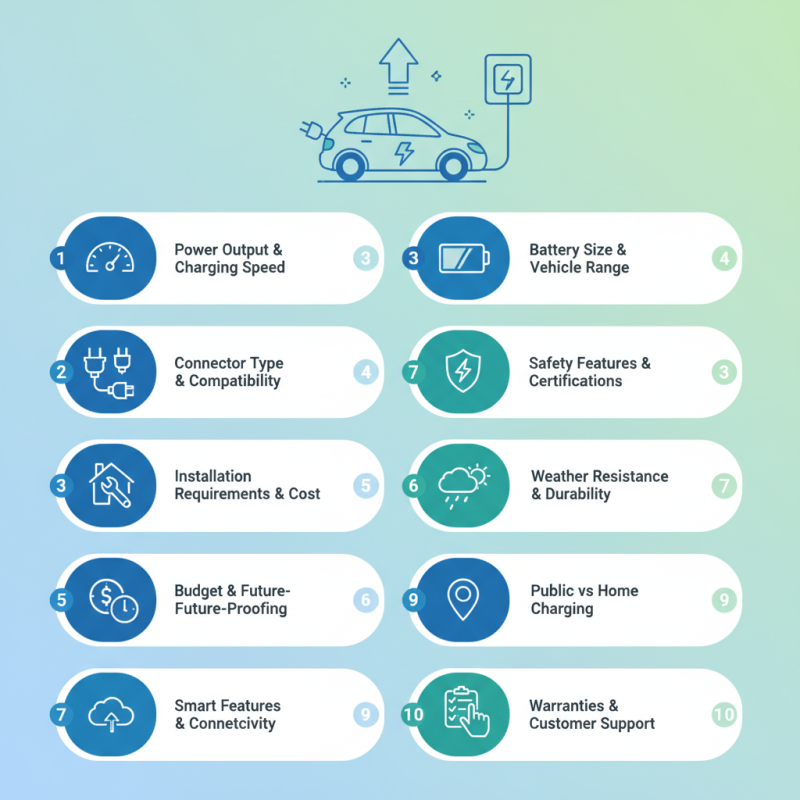
When selecting an electric vehicle charger, it’s crucial to understand the different types available.
Level 1 chargers are the most basic. They use a standard household outlet and deliver about 4-5 miles of range per hour. This option is suitable for overnight charging at home. However, it is slow. Many users find that they need something faster.
Level 2 chargers offer a significant upgrade. They are commonly found in public charging stations and can provide up to 25 miles of range per hour. This requires a 240-volt outlet, usually installed in homes. For those who drive long distances frequently, this option might be more practical. It's important to note the installation can be costly and complicated for some.
DC fast chargers are the quickest. They can charge an electric vehicle to 80% in about 30 minutes. These are typically found at highway rest stops, ideal for road trips. However, they are not suitable for home use. Access to these chargers may not always be reliable. Users might find themselves waiting for an available charger. Understanding these types will aid in making a more informed decision about the right charger for your electric vehicle needs.
When choosing the right electric vehicle charger, understanding power levels is crucial. Chargers are rated in watts and amps, and both metrics significantly impact charging speed. The higher the wattage, the faster a vehicle can charge. For instance, a Level 2 charger often provides 7.2 kW, equivalent to 30 amps. This rapidly adds miles of range in a short time—up to 25 miles in one hour, according to the Department of Energy.
Consumers often overlook the importance of amperage. A charger delivering 32 amps can charge a vehicle more quickly than a 16-amp unit. However, the vehicle must support the higher amperage to benefit. Realistically, many home electrical systems may not support maximum charging capabilities without upgrades. This potential limitation can lead to misconceptions about charging speeds.
Moreover, not all charging stations are created equal. A public DC fast charger can output over 150 kW, allowing for an 80% charge in about thirty minutes. Conversely, a standard outlet offers just 1.4 kW. Understanding these dynamics helps customers make informed decisions and avoid disappointment in charging experiences. With the right knowledge, selecting an appropriate charger becomes a less daunting task.
When considering an electric vehicle charger, it’s crucial to assess the charging speed. There are three main types: Level 1, Level 2, and DC Fast Chargers.
Level 1 chargers are the most basic. They use a standard outlet, delivering about 4 to 5 miles of range per hour. This is suitable for overnight charging but may not meet the needs of daily drivers.When selecting an electric vehicle charger, compatibility is key. Not all chargers work well with every electric vehicle. Each EV has specific charging requirements. The Society of Automotive Engineers states that different charging standards exist. Understanding these variations can enhance efficiency.
Home systems also play a crucial role in charger compatibility. Each household's electrical capacity can differ. The U.S. Department of Energy emphasizes that some homes may need electrical upgrades. For instance, a Level 2 charger often requires a dedicated circuit of 240 volts. Ensure your home meets these requirements before purchasing a charger.
You might face limitations if your home can’t support certain chargers. Moreover, local incentives sometimes push for specific types of installations. A recent study found that over 40% of homeowners reported confusion over charger compatibility with their home systems. This highlights the need for proper evaluation before making a choice.
| Tip | Description | Compatibility | Installation Type | Charging Speed |
|---|---|---|---|---|
| 1. Know Your EV's Specifications | Check the charging requirements of your electric vehicle. | Ensure charger matches your EV model. | Home/Office | Varies |
| 2. Check Electrical System | Assess your home’s electrical capacity for new chargers. | Compatibility with home wiring. | Home | N/A |
| 3. Charging Speed Options | Understand Level 1, Level 2, and DC fast charging. | Check EV support for charging levels. | Home/Work | Up to 350kW |
| 4. Look for Smart Features | Consider chargers with Wi-Fi and app control. | Smartphone compatibility required. | Home | Varies |
| 5. Evaluate Plug Types | Identify plug type compatible with your vehicle. | Match vehicle connector type. | Home/Public | N/A |
| 6. Budget Considerations | Set a budget for purchase and installation costs. | N/A | Home/Office | N/A |
| 7. Verify Warranty and Support | Ensure adequate warranty and customer service. | N/A | Home | N/A |
| 8. Read Reviews and Ratings | Check user reviews to gauge reliability. | N/A | Home/Public | N/A |
| 9. Consider Mobility Options | Look for portable charging solutions if needed. | N/A | Portable | Varies |
| 10. Check Local Incentives | Research incentives for EV chargers in your area. | N/A | Home/Work | N/A |
Choosing the right location for your electric vehicle charger requires careful consideration. Analyze your parking situation first. Is it in a garage or outside? This affects installation choices. Avoid placing chargers in hard-to-reach areas. You want easy access, especially during bad weather.
Installation costs can vary widely. They depend on your home's electrical capacity and distance to the power source. Have a professional assess your property. This prevents unforeseen expenses later. Ensure the placement facilitates daily usage. For example, if you park on the street, a wall-mounted charger could be ideal.
Consider local regulations too. They can dictate where you can install a charger. This adds another layer to your planning. Don’t rush this process. Mistakes or oversights can lead to increased costs. Take the time to plan for an optimal charger placement.
: There are three main types: Level 1, Level 2, and DC fast chargers. Each offers varying charging speeds and requirements.
A Level 1 charger delivers about 4-5 miles of range per hour. It's suitable for overnight home charging but is quite slow.
Level 2 chargers provide up to 25 miles of range per hour. They are commonly found in public stations but require a 240-volt outlet.
DC fast chargers can charge a vehicle to 80% in about 30 minutes. They are great for quick stops during road trips.
Chargers rated in watts and amps affect charging speed. Higher wattage means faster charging, which can add miles quickly.
Consider your parking space and accessibility. Installation costs vary by location and electrical capacity. Professional assessment is recommended.
No, local regulations can impact where you can install a charger. Planning is essential to avoid compliance issues.
Not all charging stations are equal. Some may have unreliable access, and users might wait for chargers to become available.
Many people misunderstand amperage's role. A higher amp delivery means faster charging, but the vehicle must support it.
Rushing can lead to mistakes and increased costs. Make sure to take your time to ensure optimal charger placement.
Choosing the right Electric Vehicle Charger is crucial for optimizing the charging experience and ensuring compatibility with your vehicle's needs. First, it is essential to understand the various types of chargers available, such as Level 1, Level 2, and DC Fast Chargers, each offering different charging speeds and power levels measured in watts and amps. Evaluating these factors helps in determining the efficiency of charging and the time required to recharge your vehicle.
Moreover, compatibility with your specific electric vehicle and home systems plays a vital role in selecting the appropriate charger. It's important to assess installation costs and the location for optimal charger placement, as this can significantly impact convenience and accessibility. By considering these aspects, you can make an informed decision, ensuring your charging solution meets your requirements and enhances your overall electric vehicle experience.

Tongxing